Wall Clocks Guide: Sizes, Styles, Movements and Where to Hang One
A wall clock is one of the few decor pieces that has to work as well as it looks. It should be easy to read from across the room, quiet enough not to bother you at night and sized to suit the wall. A clock that is too small disappears, one that is too loud keeps you awake and one with a fussy dial is hard to read. A few simple checks help you choose a clock you will actually use.
A wall clock is a timepiece that hangs on a wall. Most home clocks use a battery-powered quartz movement, though some use plug-in power or a mechanical movement. Clocks come in many sizes and styles, from small kitchen clocks to oversized statement pieces.
This guide explains how to choose a size, which styles suit which rooms, how movements differ, how to hang a clock and how to look after it. You will also find tips for readability and quiet operation.
How big should a wall clock be?
Size depends on the wall and the viewing distance. A common guide is that a clock 10 to 14 inches wide suits a kitchen, a bathroom or a small wall. A clock 14 to 20 inches wide fits most living rooms, bedrooms and offices. Oversized clocks of 24 to 36 inches or more make a statement in a large living room, an entryway or above a mantel.
Think about the distance from where you will read it. A clock should be readable from the main seating or work area. As a rough rule, the numerals or markers should be at least an inch tall for every 10 feet of viewing distance. In a large room, a bigger clock helps.
Consider the surrounding wall space. A clock should have breathing room, with several inches of empty wall around it. Hung above a sofa or console, it should be smaller than the width of the furniture, around one third to two thirds. A clock that is too large crowds the wall, and one that is too small seems lost.
What styles are available?
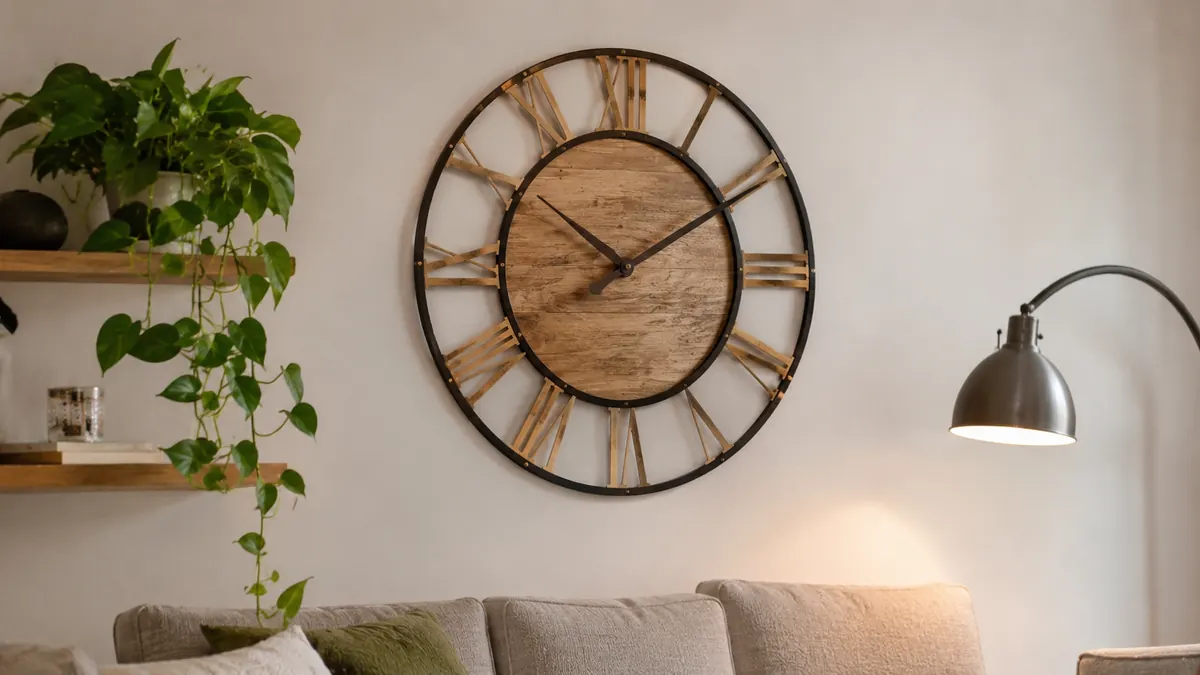
Classic clocks have round faces, Roman numerals and a framed look, and they suit traditional rooms. Modern clocks have minimal faces, clean hands and often no numbers. Industrial clocks use metal frames and big numerals, and they suit lofts and kitchens.
Farmhouse and rustic clocks use wood, distressed finishes and simple numerals. Vintage and retro clocks have starburst or mid-century shapes. Oversized and skeleton clocks, with an open face, show the mechanism or a decorative pattern. Digital and LED clocks suit offices and gyms.
Choose a style that suits your room. A neutral clock with a simple face works in most spaces. A bold or oversized clock acts as an accent, so keep the rest of the wall simple.
How do you choose readability features?
Look at the dial. High contrast between the hands and the face, such as black hands on a white background, makes the time easier to read. Large numerals help older family members and children, and a clean face without clutter is easier at a glance.
Check the hands. Long minute hands that reach the edge of the numerals make reading easier. A second hand adds precision, but a sweeping second hand is quieter than a ticking one.
For low light, consider a clock with a backlight or glow-in-the-dark hands. A clock in a bedroom may need a dimmable or non-glaring display. Choose matte glass or a non-reflective surface, so glare does not make the clock hard to read.
What movement types are there?
Most wall clocks use a quartz movement, a small battery-powered mechanism that is accurate and inexpensive. A standard quartz clock ticks once per second. A sweep or silent movement moves the second hand smoothly and makes almost no sound, which suits bedrooms and offices.
Mechanical clocks use springs and gears. They are traditional and charming, but they need winding and regular maintenance. Pendulum clocks, which have a swinging weight, give a classic look and a gentle tick.
Atomic or radio-controlled clocks set themselves from a time signal, so they stay accurate, though they depend on signal strength in your area. Plug-in electric clocks never need batteries, though you need an outlet nearby and a plan for the cord. Smart clocks sync with your phone and can show extra information.
Where should you hang a wall clock?
Choose a spot where people look. A kitchen clock sits where you cook, and an office clock sits in your line of sight. In a living room, hang the clock on the main wall, above a sofa or mantel, or opposite where people sit.
In a bedroom, keep a clock where you can see it from the bed, but avoid a loud ticking clock close to your head. In an entryway, a clock helps you check the time before leaving. In a bathroom, choose a moisture-resistant clock.
Avoid direct sunlight, which can fade the dial, and avoid hanging near heat sources and steam. Avoid hanging a clock where it will be bumped, such as near a door that opens into the wall.
How high should you hang a clock?
For most rooms, hang the center of the clock at about 60 to 66 inches from the floor, which is a little above average eye level. In a room with high ceilings, you can go higher, so the clock is visible from a distance. In a kitchen or a children’s room, hang it at a height that is easy to see from the main work or play area.
Above furniture, leave 6 to 10 inches between the clock and the top of the piece. Above a mantel, center the clock on the fireplace. If you hang a clock as part of a gallery wall, treat it like another piece and keep spacing consistent.
Use a level and a pencil to mark the wall before you hang the clock. A clock that tilts is more noticeable than a crooked picture.
What hardware do you need?
Check the weight of the clock. Light clocks, up to a couple of pounds, can hang on a small nail or a picture hook. Heavier clocks need a screw or a heavy-duty hook, ideally in a stud. For drywall, use a wall anchor rated for the weight of the clock.
Many clocks have a keyhole slot at the back. Position a screw with its head slightly proud of the wall, and slide the clock down. For very large clocks, use two hooks, and a level, to keep the clock straight. In a rental, adhesive strips can hold lightweight clocks, but check the weight limit.
For plug-in clocks, plan the cord route. Use a cord cover painted to match the wall, or a clock with a battery backup.
How do you take care of a wall clock?
Replace batteries once a year, or when the clock begins to slow. Use good-quality alkaline batteries, and remove them if you store a clock for a long time to avoid leaks. Dust the face and frame with a soft cloth, and wipe glass with a gentle cleaner. Do not spray cleaner directly on the clock.
If the clock runs slow or stops, try a new battery first. If the hands touch each other or the glass, adjust them gently or consult a clock repair shop. Mechanical clocks need regular winding and oiling, and an occasional service.
Move the clock carefully, and keep it level. Do not hang it where the temperature changes a lot, since this can affect the movement.
What mistakes should you avoid?
The most common mistake is choosing a clock that is too small. Another is picking a style with a hard-to-read dial. A third is buying a loud ticking clock for a bedroom.
Others include hanging at the wrong height, using weak hardware for a heavy clock and putting a clock in direct sun or steam. Think about the viewing distance, choose a silent movement if noise bothers you and use a level.
Frequently Asked Questions
What size wall clock should I buy?
About 14 to 20 inches for most living rooms, and 24 inches or more for large rooms or statement walls.
How high should I hang a wall clock?
Center it about 60 to 66 inches from the floor, or 6 to 10 inches above furniture.
Which wall clocks are quiet?
Clocks with a sweep or silent movement make almost no sound. They suit bedrooms and offices.
Do wall clocks need batteries?
Most do. Some are plug-in or mechanical, and atomic clocks set the time automatically.
Can I hang a wall clock without drilling?
Light clocks can use adhesive strips. Check the weight limit and follow the instructions.
Conclusion
A good wall clock is easy to read, quiet and in proportion to the wall. Choose a size that suits the room and viewing distance, a style that matches your decor and a movement that suits where it hangs.
Hang it at the right height with proper hardware, and change the battery regularly. With a few simple checks, a wall clock is both a useful tool and a stylish accent.
Related guides
 Gallery Wall Guide: Layouts, Spacing, Frame Heights and Hanging TipsA gallery wall turns a blank stretch of wall into the focal point of a room. It lets you mix photos, prints,…Read more →
 Table Lamps Guide: Sizes, Shade Shapes, Bulbs and PlacementA table lamp does two jobs at once. It gives you light where you need it, and it adds shape, color and warmth…Read more →
 Floor Vases Guide: Sizes, Materials, Styling and What to Put in ThemA floor vase fills the awkward gaps in a room, such as an empty corner, the space beside a fireplace or the end…Read more →
 Throw Blankets Guide: Sizes, Fabrics, Care and How to Style ThemA throw blanket is the easiest way to make a sofa or bed feel inviting. It adds color, texture and warmth, and…Read more →