Kids Desk Guide: Height by Age, Adjustable Desks, Chairs and Posture
A kids desk looks like a simple purchase, but the wrong one can make homework harder. If the desk is too high, your child lifts their shoulders and gets tired. If it is too low, they hunch over and strain their neck. A good desk fits the child, grows with them and makes it easy to focus.
This article is part of our kids bedroom furniture guide, where you can compare related options.
A kids desk is a work surface sized for children, used for homework, drawing, crafts and screen time. Some are fixed-height tables. Others are adjustable desks that change height as a child grows. This guide explains how to match a desk to your child, why the chair matters as much as the desk, what features to check and how to set up a good homework spot.
Fit Beats Age
Age charts are a rough guide. Children of the same age can differ in height by 3 to 5 inches, according to one vendor guide, so it is better to check against your child’s actual body.
A simple test:
- Have your child sit on a chair with their feet flat on the floor and knees bent at about a right angle.
- Measure from the seat to their elbow, with the upper arm hanging down and the forearm bent at a right angle.
- The desk surface should sit near that elbow height.
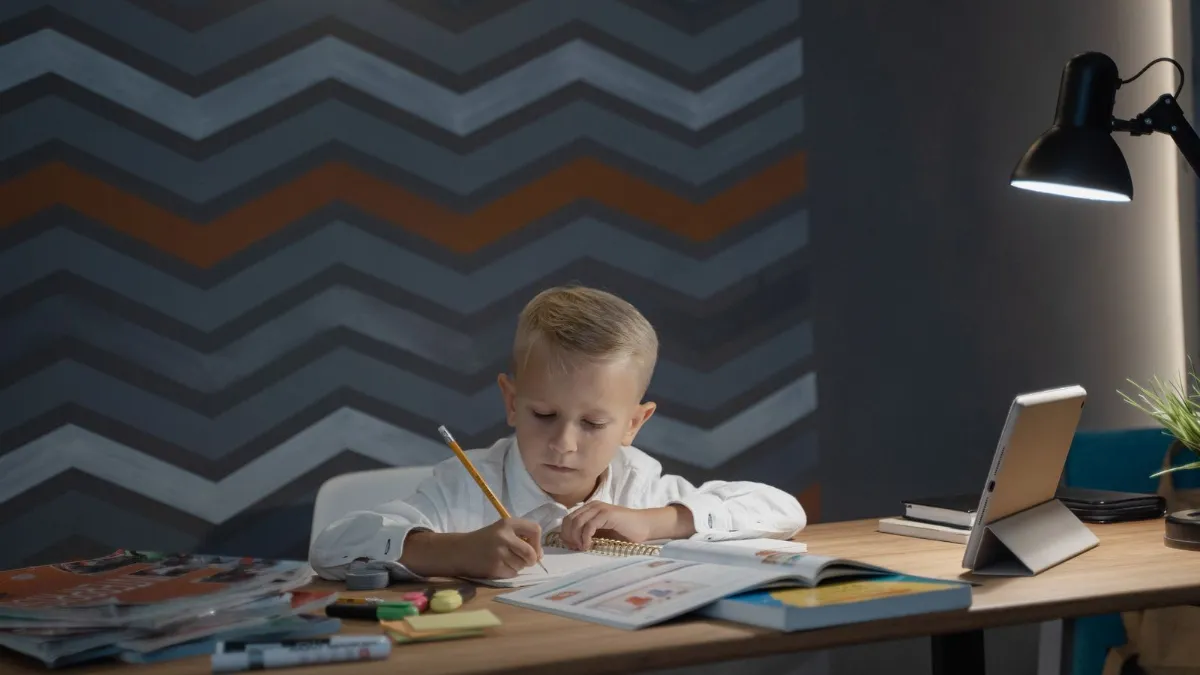
The goal is elbows bent at about 90 degrees while writing, forearms resting comfortably and shoulders relaxed, not hunched up. If the surface is too high, the shoulders rise. If it is too low, the back rounds forward.
The Chair Matters as Much as the Desk
A correctly sized desk loses its benefit if the chair is wrong. One guide warns that if you pair a child’s desk with an adult chair that cannot go low enough, the ergonomic benefit of a correctly sized desk is entirely lost.
What to look for in a chair: Seat height that adjusts, so your child’s feet rest flat on the floor. If the chair is too tall, add a footrest or a stack of sturdy books or a small stool. Seat depth that leaves a small gap between the back of the knees and the seat edge. A back that supports the lower back. Stable base, preferably with no wheels for younger children, or lockable wheels. Easy movement so the child can sit back and get up without scraping the floor.
If your child’s feet dangle, their legs go numb and they wriggle. A footrest is a cheap fix.
Adjustable vs Fixed Desks
Children outgrow fixed desks quickly. One vendor claims a fixed desk that fits at age 6 stops fitting around age 9, though growth varies. An adjustable desk lets you change the height as your child grows, so it can last for years.
One vendor example gives a 10-year-old (about 50 to 54 inches tall) a desk height of 22 to 24 inches and a chair seat of 14 to 16 inches. Another product range lists a desk adjusting from about 24 to 29 inches with a chair from about 16 to 19 inches, while another adult-style desk adjusts from 33 to 40 inches. These are manufacturer figures and they differ a lot, which shows why you should check the min and max height of each model and compare with your child’s measurements.
| Feature | Fixed desk | Adjustable desk |
|---|---|---|
| Price | Lower | Higher |
| Lifespan | Short | Years |
| Fit | One size | Grows with child |
| Stability | Usually solid | Check the frame at full height |
An adjustable desk is worth it if you want it to last through several growth stages. Look at how the adjustment works. Crank, lever or electric systems are common. Make sure it locks securely and does not slip.
Stability and Safety
Frame stability. One guide says the desk frame should stay stable across its entire height range. A wobbly frame defeats the purpose of adjustability. Press on the desktop and try to rock it. Weight capacity. Check that it can hold a laptop, books and supplies. Rounded corners. Safer for younger children. Non-toxic finishes. Look for low-VOC or child-safe finishes. Cord management. Keep cords out of reach. Anchoring. If the desk has a tall hutch or shelves, anchor it to the wall. Pinch points. Check that adjustment mechanisms cannot pinch fingers.
Surface Size and Storage
The desktop should be big enough for what your child does. Younger kids doing crafts need more width. Older kids with laptops and textbooks need more depth. Consider: a surface at least large enough for a laptop, a notebook and a mouse; a tilting top for drawing and reading; drawers or shelves for supplies; a pen tray or organizer to keep the surface clear; hooks for a school bag.
See the small desk and desk with drawers guides for related ideas on compact designs and storage.
Lighting and Location
Put the desk near natural light, with the window at the side to avoid glare on the screen. Add a desk lamp for evenings. Keep the desk away from the TV and from areas where siblings play, so your child can focus. In a shared room, a desk that faces the wall, with a divider or bookshelf nearby, helps reduce distractions. See the room divider guide for ideas.
If your child uses a computer, place the screen so the top is at or just below eye level and about an arm’s length away. See the monitor stand guide.
Building Good Habits
Key points: take a short break every 30 to 45 minutes to move around; keep the back against the chair; keep feet flat on the floor or a footrest; limit long stretches of screen time; keep the desk tidy and the supplies within reach; check posture now and then without nagging.
Choosing a Desk for Different Ages
Toddlers and preschoolers: a low table with small chairs for drawing and play. Sturdy, rounded and easy to clean. Early school age: a small desk with an adjustable chair, or an adjustable desk set at a lower setting. Storage for supplies helps. Tweens and teens: a larger desk with space for a laptop, books and a lamp. Adjustable desks that reach adult height last into the teen years.
How to Choose a Kids Desk
Measure your child’s height and seated elbow height. Choose adjustable if you want the desk to last. Pick a chair that adjusts or add a footrest. Check the frame for stability at the highest and lowest settings. Check the surface size against what your child does. Look at storage that suits their supplies. Check safety: rounded corners, non-toxic finish. Plan the location with good light and few distractions. Read reviews for notes on wobble and assembly.
What mistakes should you avoid?
A few common mistakes are worth avoiding: buying a desk to grow into that is too high now (your child will hunch or raise their shoulders); using an adult chair with no footrest (feet dangle); choosing a wobbly adjustable frame; placing the desk in front of the TV; skipping lighting; ignoring cord safety.
Frequently Asked Questions
What height should a kids desk be?
It depends on your child. Match the desk surface to their seated elbow height, with elbows bent at about 90 degrees.
Are adjustable kids desks worth it?
Usually, since children grow fast and a fixed desk may stop fitting in a few years.
Do kids need a special chair?
A chair that lets their feet rest flat on the floor or a footrest is important, so adult chairs often need help.
How big should the desktop be?
Large enough for a laptop or books and a notebook. Check how your child works.
Where should I put a kids desk?
Near natural light, away from the TV and busy areas.
How long can my child sit at a desk?
Encourage breaks every 30 to 45 minutes.
Is a standing desk good for kids?
Some adjustable desks can be raised for standing. Ask your pediatrician if you have posture or health concerns.
Conclusion
A good kids desk fits your child’s body, not just their age. Measure their elbow height, choose an adjustable desk and chair, check the frame for stability and set it up in a bright, calm spot.
With a good fit and some healthy habits, your child will find homework a little easier and more comfortable.
Related guides
 Kids Couch Guide: Safety, Foam Density, Washable Covers, Sizes and Modular Play CouchesQuick answer: a good kids couch has rounded edges, non-toxic high-density foam, a washable removable cover and…Read more →
 Kids Dresser Guide: Safety, STURDY Act, Anchoring, Drawer Size and How to ChooseA kids dresser holds clothes, but it also needs to do something more important: stay on its feet. Every year,…Read more →
 Kids Bookshelf Guide: Front-Facing Shelves, Height, Anchoring, Materials and SafetyA good kids bookshelf does more than store books. It invites a child to pick one up. A shelf at the right…Read more →
 Floor Pillows Guide: Sizes (20 to 32 Inches), Fill Types, Meditation Cushions, Covers and CleaningQuick answer: floor pillows are large cushions for sitting on the floor. A 24 inch square suits living room…Read more →