
Extendable Dining Table: Sizes, Leaf Types, Mechanisms and What to Check
An extendable dining table gives you a small table for everyday meals and a bigger one when guests come. It’s a smart fit for homes where the dining area doubles as another room, or where hosting happens only a few times a year. The trick is to understand how it extends, because the mechanism decides how easy it is to live with.
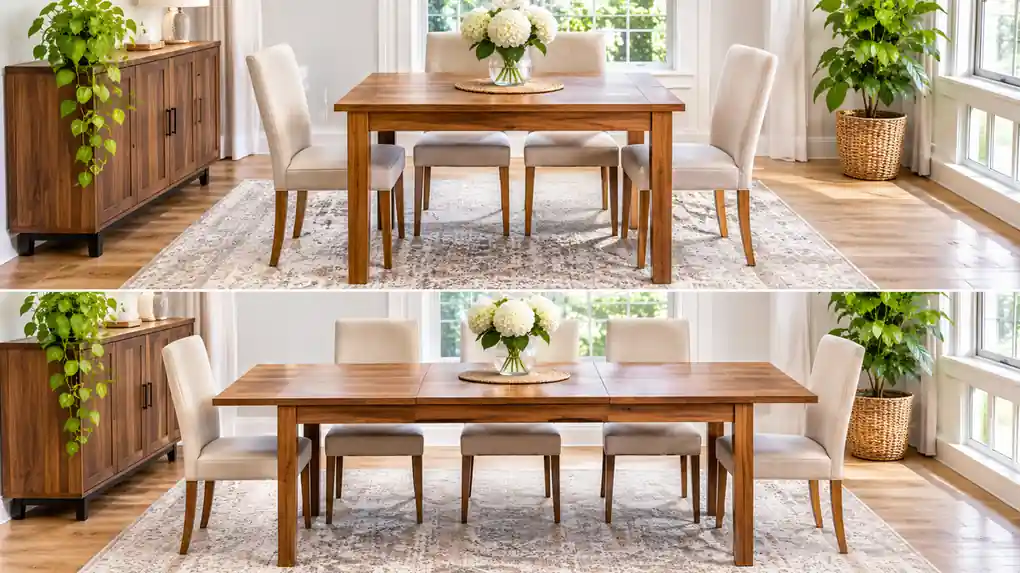
An extendable dining table is a table with a top that can grow in length, usually by adding a leaf or by sliding the two halves apart. In its closed state it takes less floor space. When extended, it seats more people, and the extra length is often 12 to 24 inches per leaf.
This guide explains the main types of extension, the sizes and seating counts to expect, how much room you need and what to check in the mechanism, the base and the finish. You’ll also find common mistakes and tips for storing leaves.
What types of extendable dining tables are there?
The three common types are butterfly leaf, drop leaf and removable leaf tables. A butterfly leaf table has a leaf that folds in half and stores under the top, so you open the table, lift the leaf and unfold it into place. This is the easiest type to use because you don’t have to store a loose leaf anywhere.
A removable leaf table has one or more separate boards that you drop in between the two halves of the top. The halves slide apart on rails, and you place the leaf in the gap. This style can add the most length, but you need space to store the leaves, such as a closet or under a bed.
A drop leaf table has hinged flaps on the sides that fold down when you don’t need them. It suits tiny spaces and kitchens, though the flaps can limit legroom and make the table less stable when raised. Some tables also have an expanding top that slides open and reveals a hidden panel.
How big is an extendable table, and how many does it seat?
Closed sizes often run from about 36 to 60 inches long, and extended sizes from about 60 to 96 inches long. A table that is 48 inches closed and 72 inches open seats about four people when closed and six when open. A table that is 60 inches closed and 84 inches open seats about six closed and eight open.
A common planning rule is to allow about 24 inches of table edge per person. Use that as a guide only, because chair width, arms and legs change the real number. Tables that seat more on paper may feel crowded if the legs sit where chairs want to go.
Check the width as well. Most dining tables are about 30 to 40 inches wide, and a width near 36 inches gives room for plates and shared dishes. A narrow table is easier to place, but it can feel tight when it’s full of food.
How much room do you need around an extended table?
Plan for about 36 inches from the table edge to the nearest wall or furniture, so people can push back chairs and get up. If people will walk behind seated guests, 44 to 48 inches is more comfortable. Measure the room when the table is fully extended, not only when it’s closed.
Add the extended length of the table to the space needed at each end. For example, a table that’s 84 inches long when open needs about 84 plus 72 inches in that direction, which is 156 inches or 13 feet. If the room is smaller, look for a table with a shorter extension or one that extends from the middle.
Think about doors, radiators, sideboards and rugs. A rug should be large enough that chair legs stay on it when guests pull back, otherwise chairs can catch on the edge. Painter’s tape on the floor is a cheap way to preview the extended footprint.
What should you check in the extension mechanism?
Check how smoothly it slides and how firmly it locks. A good mechanism moves with light effort and clicks into place, and the top stays level once it’s open. Wobble or a gap between the leaf and the top is a sign of poor build.
Look at the rails and the hardware. Metal slides are usually more durable than wood on wood, and ball bearing slides run smoothest. Ask the maker how much weight the extended top is rated to carry, since a long span is weaker than a short one.
Try the extension a few times before you decide, if you can test it in a store. At home, check that you can open and close the table alone, and that the leaf lines up with the top without gaps. Finally, ask about spare parts and warranty, because a worn slide is the most common repair.
Which base and legs work best?
A pedestal base or a trestle base can give you more legroom than four corner legs. When the table extends, the legs on a four-leg table can end up in awkward spots for chairs. Make sure that the legs stay clear of the seating positions in both the closed and open sizes.
Check the stability when open. A lightweight table with thin legs can rock under a heavy meal or when someone leans on the edge. A wider base and a steady frame matter more than looks.
Also look at the apron, which is the frame under the top. A deep apron can block knees, especially on armchairs. Standard table height is around 28 to 30 inches, and chairs with a seat height of about 17 to 19 inches usually fit.
What materials and finishes last?
Solid wood tops are durable and can be refinished, but they can change with humidity, and a leaf may need an adjustment through the seasons. Veneer over a stable core is common and handles changes well, though deep scratches can show the core. Laminate and similar surfaces cost less and wipe clean, but they can chip at the edges.
Glass tops look light, but extending glass tables are rarer and need strong hardware. Ask whether the leaf matches the top in color and grain. On wood tables, a leaf made at the same time as the table matches best, and a leaf bought later may not.
Protect the finish with placemats and coasters, and wipe spills quickly. Hot dishes can mark some finishes, so use trivets.
How do you store the leaves?
If your table uses a removable leaf, plan where to keep it. A closet shelf, under a bed or behind a sofa works well. Store it flat and upright, and wrap it in a soft blanket so it doesn’t scratch. Keep it away from heat and damp so it doesn’t warp.
Some tables come with a leaf storage cabinet or a sleeve. If yours doesn’t, a padded storage bag helps. Don’t lean a leaf at an angle for long periods, because it can bend over time.
A butterfly leaf stores in the table itself, which is a big plus if you have no spare closet. Make sure the opening and closing are easy so you’ll actually use it.
What mistakes should you avoid?
The most common mistake is measuring only the closed table. Always check the room with the table extended. Another is ignoring where the legs fall, which can block chairs. A third is skipping the weight rating.
Many people also forget to think about use. If you’ll extend the table every week, choose a butterfly or a simple slide. If you’ll do it twice a year, a removable leaf is fine. Finally, don’t ignore the return policy and the warranty on the mechanism.
Frequently Asked Questions
How many people does an extendable dining table seat?
It depends on the size. A table that’s 60 inches closed and 84 inches open seats about six closed and eight open.
What is a butterfly leaf?
It’s a leaf that folds in half and stores under the tabletop, so you don’t need to find a place to keep it.
How much space do I need around an extended table?
About 36 inches from the edge to a wall, and 44 to 48 inches if people walk behind chairs. Measure with the table fully extended.
Are extendable tables sturdy?
Good ones are, if the mechanism is solid and the legs are stable. Check the weight rating and test it.
Can I add a leaf later?
Sometimes, but a leaf bought later may not match the finish. Ask the maker about extra leaves.
Conclusion
An extendable dining table is a good choice when your room is small but your guest list sometimes isn’t. Pick the type of extension that fits how often you’ll use it, measure the room at full length and check the mechanism and legs.
Look at the weight rating, the finish and the warranty. A table that opens easily and stays stable will serve you for everyday meals and special days alike.
Related guides
 Counter Height vs Bar Height: Differences, Stool Sizes and Which to ChooseCounter height and bar height are two common table heights, and they re easy to mix up. Both are taller than a…Read more →
 Upholstered Dining Chairs: Fabrics, Comfort, Cleaning and How to ChooseUpholstered dining chairs are more comfortable than bare wood or metal, and they add color and texture to a…Read more →

3 Comments