
Kitchen Cart Guide: Sizes, Materials, Casters and How to Choose One
A kitchen cart is a small rolling table you can park next to the counter, use as extra prep space and wheel away when you’re done. It’s one of the easiest ways to add storage and workspace to a kitchen that feels too tight. Because it moves, it also works in rented homes where you can’t build an island.
A kitchen cart is a compact piece of furniture on wheels, usually with a work surface on top and shelves, drawers or a rack below. Some carts have a drop-leaf side that folds up for extra room. Others are closer to small islands, with a butcher-block top and a stool tucked at one end.
This guide explains the main types of carts, the sizes that fit common kitchens, which materials last and what to check on casters and weight limits. It also covers where to put a cart and the mistakes that make people send them back.
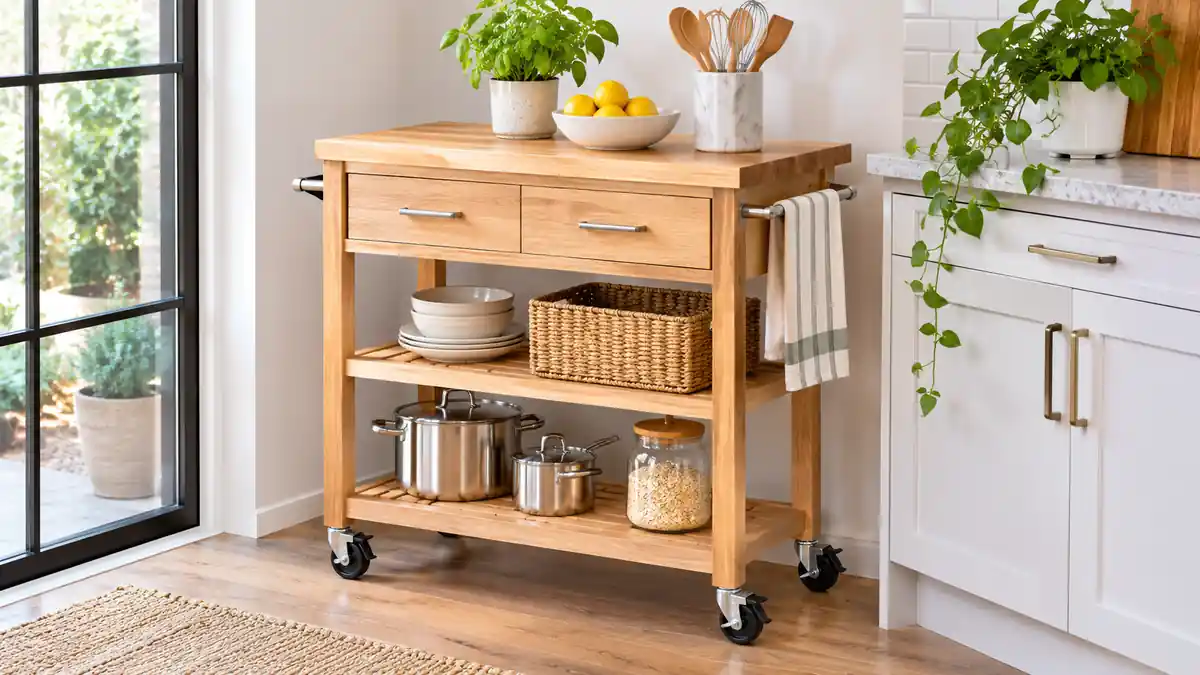
What is the difference between a kitchen cart and a kitchen island?
A kitchen cart is smaller and movable, while a kitchen island is bigger and usually fixed to the floor. A cart can roll to where you need it, and it can leave the room when guests come over. An island stays put and often holds a sink, a cooktop or seating.
A cart also costs far less and needs no installation. The tradeoff is stability. Even with locking wheels, a cart can shift if you lean on it hard or chop on it with force, so it suits light prep, serving and storage better than heavy work.
If you want seating, look for a cart with a wide top and a stool that fits under the edge. Check the overhang before you buy, since a cart with no overhang leaves no room for knees.
What sizes do kitchen carts come in?
Most carts are about 30 to 48 inches wide, 15 to 25 inches deep and 32 to 36 inches tall. The height is usually close to a standard 36-inch kitchen counter so the cart works as an extension of it. Small apartment carts can be as narrow as 15 inches, and larger island-style carts can reach 60 inches or more.
Measure the space where the cart will live, then add room to move around it. A good habit is to leave at least 36 inches of walkway next to a cart in a small kitchen, and more if two people cook together. Also measure the doorway or path if you plan to roll the cart into another room.
Check the depth as well as the width. A cart that is 24 inches deep gives you a real work surface, while a 15-inch-deep cart is better for serving or storing spices.
What should a cart be made of?
Wood and metal are the most common frames, and each has strengths. Solid wood looks warm and holds up well, but it can warp if it stays wet. Engineered wood and particleboard cost less, but they can swell if water reaches the edges, so wipe spills fast.
Metal frames are sturdy and easy to clean, and steel carts hold heavy items well. Stainless steel is also good around food because it doesn’t stain easily. For the top, butcher block is warm and can be sanded, though it needs oiling. Granite and marble tops look rich and stay cool for baking, but they’re heavy and can be damaged by hard hits.
Read the product page for the weight rating. Makers list a limit for the top and sometimes for each shelf, and the numbers differ a lot from model to model. Don’t stack a heavy mixer and a full set of pots on a cart that’s rated for much less.
How do casters and locks work?
Casters are the small wheels at the base, and good ones make a cart easy to move and safe to use. Look for at least two locking wheels, and four is better. A locked wheel should stop the cart from rolling when you chop, stir or lean on it.
Wheel size and material matter. Larger wheels roll more easily over thresholds and uneven floors. Rubber wheels are quieter and gentler on hardwood and tile, while hard plastic wheels can leave marks. If your floors are easy to scratch, add felt or soft pads, or choose rubber wheels from the start.
Check how the wheels attach. Bolted wheels are usually sturdier than the push-in kind. If the cart arrives with wobbly wheels, tighten the bolts first, then contact the seller if it still wobbles.
What storage features are worth paying for?
Choose storage by what you actually keep. Drawers hide small tools and keep the top clear. Open shelves hold cookbooks, baskets and appliances you use daily, but they show clutter. A towel bar, hooks and a spice rack on the side help in small kitchens where wall space is scarce.
A drop-leaf cart is a smart pick when floor space is tight. You fold the leaf down to save room, then raise it when you need more surface. A cart with a built-in wine rack suits entertaining, but it adds little for daily cooking.
Make sure the shelves are adjustable if you plan to store tall items. Also think about weight distribution, since heavy things belong on the lower shelf to keep the cart steady.
Where should you put a kitchen cart?
Put it where it adds workspace without blocking the main path. Next to the main counter is a common choice, because it extends your prep area. Beside the stove, a cart can hold oils, spices and a cutting board. Near the dining area, it works as a serving station.
Keep it away from heat and splashes. Don’t park it right in front of the oven door, and don’t leave it in direct sun if it’s made of wood. If the cart will hold small appliances, check that you have an outlet within reach and don’t run cords across the walkway.
In a very small kitchen, think about a cart that tucks into a gap between the refrigerator and the wall. A slim rolling cart about 6 to 10 inches wide can hold cans and jars in a space that would otherwise go to waste.
What mistakes should you avoid?
The first mistake is buying by looks without checking size. A cart that’s too wide blocks the aisle, and a cart that’s too tall or short won’t line up with the counter. Measure first, and tape the footprint on the floor.
The second is ignoring the weight rating. The third is forgetting about assembly, since many carts arrive flat-packed and take an hour or more to build. The fourth is skipping the locks, which makes the cart unsafe to cut on. And the fifth is leaving wood carts wet. Wipe up spills and keep the finish in good shape.
Finally, check the return policy. A cart that looked right online may look bulky in your room, and an easy return saves a lot of trouble.
Frequently Asked Questions
What size kitchen cart should I buy?
Most carts are 30 to 48 inches wide and 32 to 36 inches tall. Pick the width that leaves at least 36 inches of walkway.
Are kitchen carts stable?
They’re stable with locking wheels and a light load. For heavy chopping or leaning, a fixed island or a counter is safer.
What is the best material for a kitchen cart?
It depends on use. Stainless steel is easy to clean, solid wood is durable but needs care, and butcher block tops are warm but need oiling.
Can a kitchen cart work as a dining table?
Some can seat one or two people if they have enough top width and overhang. Check the dimensions and stool height first.
How much weight can a kitchen cart hold?
It varies widely by model. Read the weight rating on the product page for both the top and the shelves.
Conclusion
A kitchen cart gives you flexible counter space and storage without a remodel. Measure your kitchen, choose a size that leaves a clear walkway and pick locking wheels you trust. Look at the weight rating before you load it up.
If you rent or have a small kitchen, a cart is one of the most useful pieces you can add. Choose one that matches the height of your counter, and it will feel like part of the room.
Related guides
 Kitchen Shelves: Open Shelving Sizes, Materials, Weight and Install TipsKitchen shelves are a quick way to add storage and style without the cost of new cabinets. They keep everyday…Read more →
 Bar Stools for Kitchen: Seat Height, Size, Style and Comfort GuideThe right bar stools make a kitchen counter feel like a place to sit, not just a place to work. The wrong ones…Read more →
 Pantry Cabinet Guide: Sizes, Types, Shelving and How to Choose OneA pantry cabinet gives your kitchen a home for dry food, small appliances and bulk items that don t fit in…Read more →
 Kitchen Island With Seating: Size, Overhang, Clearance and Stool HeightA kitchen island with seating gives you a spot to cook, eat and talk in the same place. It adds counter space…Read more →

3 Comments