Curved Sofa Guide: Sizing, Bounding Box, Delivery, Rug Placement and Wall Placement
A curved sofa softens a room. Where most furniture is straight and boxy, a curved sofa wraps around a space, looks organic and invites conversation. It is one of the most popular living room trends, and for good reason. But curves behave differently from straight lines. They take up more room than they seem to, they are harder to fit against a wall and they can be tricky to deliver.
This article is part of our sofa and couch buying guide, where you can compare related options.
A curved sofa is a sofa with a rounded or arc-shaped back and front, instead of straight lines. It may be a gentle curve, a half-moon or a modular arc. This guide explains how to measure, why the “bounding box” matters, how to plan delivery, how to place a rug and the sofa itself, how to choose a fabric (including boucle) and what to avoid. For U.S. rooms, measure your own space carefully.
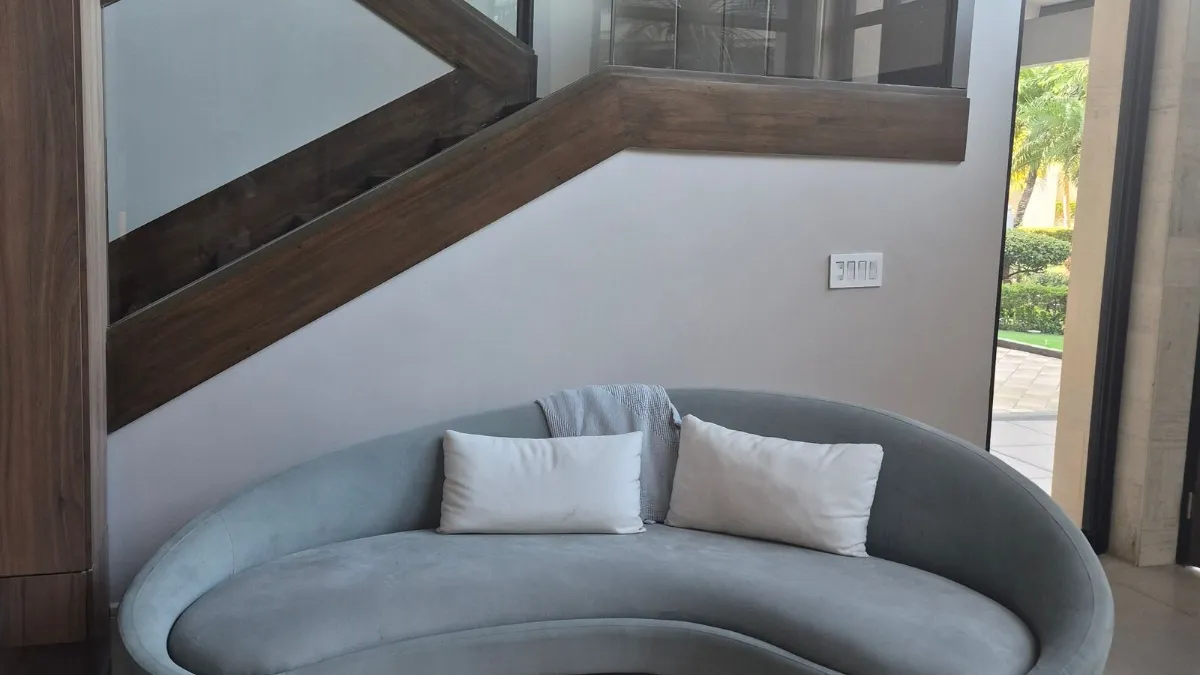
Why Choose a Curved Sofa?
Key points: soft, modern look. Curves ease sharp corners in a room; good for conversation. The arc faces people toward each other; works in open spaces. It divides a room gracefully; a statement piece; pairs well with round tables and rugs; friendly to traffic flow. No sharp corners.
The Bounding Box
Look past the graceful lines of a curved sofa and visualize its “bounding box.” This is the imaginary rectangle enclosing the outermost points of the sofa.
A curved sofa that looks 84 inches wide may need a much larger rectangle of space, because the curve pushes the ends forward. Always measure:
- Overall width at the widest points.
- Overall depth from the back’s farthest point to the front’s farthest point.
- Height.
- Seat depth and height.
- Arm and back height.
Then tape a rectangle on the floor equal to the bounding box and walk around it. The empty corners of that rectangle are lost space. Sources also point to guides on what to measure before buying a curved sofa. Check manufacturer dimensions.
Sizing for Your Room
Retailer guidance for Singapore flats (HDB) says a large curved sofa can overwhelm a typical 4-room HDB living room, and a smaller curved two-seater or a modular arc is easier to fit. One guide says a mid-size curved sofa usually suits a 4-room HDB or larger. A 2-seater at roughly 140 to 170 centimeters (about 55 to 67 inches) wide, or a modular setup, can work in a 3-room flat. That context is Singapore-specific, but the lesson applies anywhere: curved sofas need more room than straight ones of the same seating width.
General sizing tips: Leave walkways of about 30 inches around the sofa. Plan a coffee table that fits the curve. A round or curved table works. See the wood coffee table and glass coffee table guides. Think about ceiling height and sightlines. Choose a smaller curve for small rooms.
Delivery
Measure the route before purchase. One guide advises tracing the exact path the delivery team will take from the delivery vehicle to your living room. Another notes that a door, turn, stair, elevator or room entry can fail, which would call for a smaller size or a different configuration.
Product listings flag packaging risk. One roundup notes that large packaging may cause delivery challenges, and a product listing warns that a large box may not fit through standard doors.
Delivery checklist: measure doors, hallways, stairs, elevators and landings; check turning radius at corners; ask the seller about the packaged dimensions; ask if the sofa ships in modules; check the return policy and return costs; consider white-glove delivery.
A modular curved sofa, made of several pieces, is easier to move. See the modular sofa guide.
Rug Placement
The most common advice is to size the rug so the front legs of the sofa sit on it. It should be large enough to fit under the front legs of the sofa and any accompanying furniture. A round or oval rug works particularly well with a curved sofa, echoing its shape and creating a cohesive look. See the washable area rugs guide.
Tips: Use a rug at least large enough for the front legs of every seat. Choose a round or oval rug for a curved sofa and round table. Leave a border of floor around the rug. Use a non-slip pad.
Wall Placement
One guide warns against pushing a curved sofa flat to a wall. It says this forces the outer corners of the sofa to press against the wall while leaving an awkward, dusty gap in the middle. It suggests filling the gap with a lamp, plant or console if a wall placement is unavoidable.
Better options: Float the sofa in the room, a few feet from the wall. Place a console table behind the sofa. See the couch table guide. Use the curve to define a seating area, facing a TV or fireplace. Place against a curved wall, if you have one. Fill the gap with a plant or lamp if you must place it against a flat wall.
Fabrics, Including Boucle
Curved sofas are often upholstered in soft, textured fabrics.
Boucle. One guide says the textured, looped surface genuinely suits the organic curves of this sofa style. A Singapore retailer also claims the durability of boucle fabric makes it ideal for homes with pets and children. Those are marketing claims, so verify them. See the boucle chair guide for pros and cons. Velvet. Rich but shows marks. Linen and cotton blends. Casual. Performance fabric. Good for families. Leather. Wipeable. See the leather couch guide. Chenille. Soft.
A boucle sofa is pricier than most fabrics, and a roundup notes that one model’s lower seat height may not suit everyone.
Light colors show dirt. See the white couch guide.
Comfort
Test the seat height and depth. Check the back support. Check how the curve feels when you sit at the ends. Check cushion quality. High-density foam holds shape. Check the frame. Curved frames are more complex. Look for a strong frame and warranty. See the sofa set guide.
Styling
Key points: pair with round or curved tables; use a round rug; add pillows in varied shapes. See the pillow covers and bolster pillow guides; soft lighting; keep other furniture simple; add a floor lamp behind the curve; use plants to soften.
See the modern bathroom ideas guide for how curves and straight lines work together in other rooms.
What are the main strengths and weaknesses?
On the plus side: soft, stylish look; great for conversation; works well in open rooms; no sharp corners. On the downside: takes more space than a straight sofa of the same seating; hard against flat walls; delivery can be tricky; often costs more; slipcovers are harder. See the sectional couch covers guide.
How to Choose a Curved Sofa
Measure your room and the bounding box. Tape the footprint on the floor. Plan delivery routes. Decide on size and modular or fixed. Choose a fabric for your household. Plan a rug and tables. Plan placement away from the wall. Check the frame and warranty. Test comfort. Check the return policy.
What mistakes should you avoid?
A few common mistakes are worth avoiding: measuring only the width; pushing it flat against a wall; ignoring delivery; buying a sofa too large for the room; choosing a rug that does not fit; trusting marketing claims on boucle durability.
Frequently Asked Questions
Are curved sofas practical?
They can be, if you plan the space, delivery and placement.
How much space does a curved sofa need?
More than its width suggests. Measure the bounding box.
Where should I put a curved sofa?
Float it in the room, away from walls, or fill the gap behind it with a console, lamp or plant.
What rug works with a curved sofa?
A round or oval rug that fits under the front legs.
Is boucle good for a curved sofa?
It suits the shape visually. Durability for pets and kids is a marketing claim, so verify.
Are curved sofas hard to deliver?
They can be. Measure the route and ask about packaging.
Conclusion
A curved sofa brings softness and character to a living room, but it asks for planning. Measure the bounding box, check the delivery route, give it space to float and choose a rug and table that echo its shape.
Pick a fabric that fits your household. With the right planning, a curved sofa becomes a beautiful and welcoming centerpiece.
Related guides
 Sofa with Chaise: Left vs Right Facing, Measuring and What to CheckA sofa with a chaise is a sofa with one extended seat where you can stretch out your legs. Left-facing and…Read more →
 Small Sofa Guide: Loveseat and Apartment Sofa Sizes (48 to 84 Inches), Arms, Depth and Fit for Small RoomsQuick answer: a small sofa can be a compact loveseat (about 48 to 58 inches wide and 30 to 34 inches deep) or…Read more →
 Curved Couch Guide: Sizing for Small Rooms, Placement, Pros, Cons and What to MeasureQuick answer: a curved couch has a bowed back and front that soften a room and invite conversation. A 2-seater…Read more →
 Couch Table Guide: Sofa Table Height, Width, Depth and Walkway SpaceWhen people search for a couch table, they often mean one of two things: a narrow table that sits behind the…Read more →