Twin Over Full Bunk Bed Guide: Dimensions, Weight Limits, Guardrails and Safety Checks
Quick answer: a twin over full bunk bed has a twin mattress (38 by 75 inches) on top and a wider full mattress (54 by 75 inches) on the bottom. Frames are roughly 78 inches long, 56 inches wide and 54 inches tall in listings. Weight limits vary by maker, so use the number printed in your manual, and a retailer notes that top bunks are recommended for children 6 and older.
This article is part of our bed frame guide, where you can compare related options.
A twin over full bunk bed suits families that need to sleep a child on top and a larger child, parent or guest on the bottom. The wider lower bunk makes it popular for guest rooms and family rooms. But bunk beds carry real safety needs: weight limits, guardrails, ladder safety and age rules. This guide explains dimensions, weight limits, guardrails, ceiling height, mattress rules, safety, and how to choose. The age guidance came from retailer pages, not from CPSC itself, and no source gave a ceiling clearance figure. This is not safety certification advice.

What Is a Twin Over Full Bunk Bed?
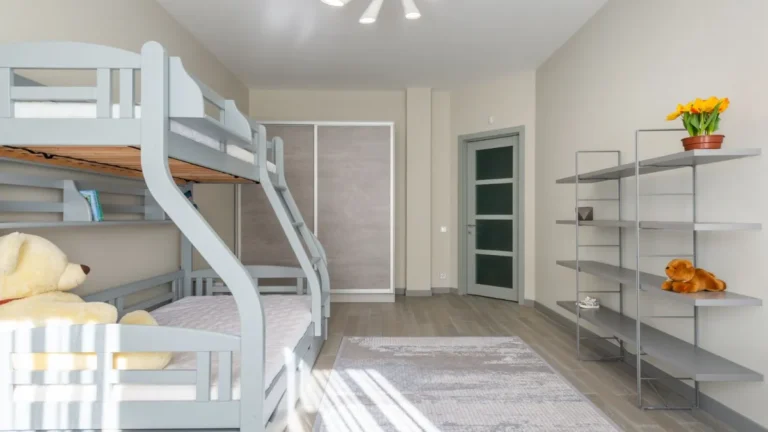
It is a bunk bed with two mattress sizes: Top bunk: twin, about 75 inches long by 38 inches wide. Bottom bunk: full, about 75 inches long by 54 inches wide.
A manual lists mattress sizes of 75 by 38 inches for the twin and 75 by 54 inches for the full. See the twin mattress dimensions, twin vs full and full size bed dimensions in feet guides. The top bunk is narrower than the bottom, so the frame looks stepped.
Typical Dimensions
Listings show: One metal model: about 78.1 inches long by 56.4 inches wide by 53.9 inches tall, with an assembled weight of 71.14 pounds. Another: 77.5 by 56.5 by 54 inches. A wooden model lists upper bed dimensions of 79.5 by 42 by 51.5 inches (length, width, height), which is the narrow top part.
Note that the total height of the unit is not the same as the “height” of some listings, which can refer to a part of the bed. The listed height of about 54 inches looks low for a full bunk, so check the product specs for the overall height. Confirm overall height and the clearance above the top mattress. See the full size loft bed and twin loft bed guides for a general guideline of 30 to 36 inches above the mattress that sellers mention for lofts.
Weight Limits
Weight limits vary a lot by manufacturer.
One listing gives 450 pounds for the lower bunk and 200 pounds for the upper bunk. Another gives 250 pounds for the upper and 350 pounds for the lower. A manual specifies 400 pounds per bunk.
Use the limit printed in the specific product’s manual. Remember to count bedding, mattresses and anything else on the bed. Do not allow several children to play on the top bunk at once.
| Source type | Example limits |
|---|---|
| Listing A | Lower 450 lb, upper 200 lb |
| Listing B | Upper 250 lb, lower 350 lb |
| Manual | 400 lb per bunk |
Guardrails
Full-length guardrails on the upper bunk are standard. Listed heights run about 12.5 to 14 inches. One model lists 14-inch guardrails, and another lists 12 inches. A manual for one twin over full model says to always use guardrails on both long sides of the upper bunk.
Check: Guardrails on all open sides, including the wall side if the maker requires it. The gap between the guardrail and the mattress. That the mattress thickness matches the maker’s limit. A thick mattress reduces effective guardrail height. See the full size loft bed guide for the 5-inch above-mattress guideline some sellers mention for lofts. A secure ladder or stair.
Age Guidance
One retailer page notes that CPSC recommends top bunks not be used for children under 6. I did not find this on CPSC’s own site in the results, so verify it on CPSC.gov and in the manual. Many other retail listings repeat the age 6 guidance for lofts and top bunks. Young children should sleep on the bottom or in a low bed.
Ladder vs Stairs
Ladder (angled or straight). Takes less space. Ensure it has flat rungs for comfort. Flat ladder. One listing lists a flat ladder, easier on feet. Stairs with storage. More stable but takes space.
Teach children to climb facing the ladder, one at a time.
Metal vs Wood
Metal. Lighter and often cheaper. Check for sharp edges and sturdy welds. The metal model listed above weighs about 71 pounds assembled. Wood. Heavy and sturdy. Costway lists a solid wood twin over full bunk bed with integrated ladder and safety guardrails. Convertible designs. Some split into two beds.
Check reviews for squeaks and wobble.
Trundle and Extra Features
Some twin over full bunks come with a twin trundle, for a third sleeper. Atlantic Fine Furniture sells one with a ladder, a twin-size trundle and a safety guardrail. A trundle adds a rating, so check its limit.
Safety Checklist
Key points: read the manual; tighten bolts after assembly and regularly after; place on a level floor away from fans, lights and windows; no jumping or roughhousing; do not hang items on the guardrails; use a night light; check for recalls on CPSC.gov; keep bedding off the guardrails so rails stay visible; do not use for adults unless the maker rates it for adults. See the bunk beds for adults guide.
Mattress Requirements
Use the mattress sizes in the manual: twin on top and full on the bottom. Check the maximum thickness. Do not add extra mattresses or a box spring unless allowed. See the best memory foam mattress guide for thin mattress options.
What are the main strengths and weaknesses?
On the plus side: sleeps two in a small footprint; full bottom bunk fits larger kids or adults; great for shared rooms; often cost-effective. On the downside: top bunk needs age restrictions; heavy and hard to move; making the top bed is awkward; weight limits vary.
How to Choose a Twin Over Full Bunk Bed
Measure the room and ceiling. Check overall dimensions. Check weight limits for each bunk. Check guardrail height and mattress rules. Choose a ladder or stairs. Choose wood or metal. Check age guidance (CPSC.gov). Decide on a trundle. Check warranty and reviews. Plan assembly.
What mistakes should you avoid?
A few common mistakes are worth avoiding: putting a young child on the top bunk; ignoring weight limits; using too thick a mattress; not tightening bolts; placing near a ceiling fan; trusting a single listing’s dimensions.
Frequently Asked Questions
What are the mattress sizes?
Twin on top (38 by 75 inches) and full on the bottom (54 by 75 inches).
How much weight can it hold?
It varies, from 200 to 450 pounds per bunk in listings. Check your manual.
What age is the top bunk for?
A retailer cites CPSC’s recommendation of 6 and older. Confirm on CPSC.gov.
How high are the guardrails?
Listings show about 12 to 14 inches.
Is metal or wood better?
Both can work. Wood is sturdy and heavy, and metal is lighter. Check reviews.
How much ceiling height do I need?
The search found no figure. Check the maker’s manual.
Conclusion
A twin over full bunk bed gives a smart sleeping solution for families. Check the dimensions, weight limits, guardrail height and age guidance, and tighten the hardware often.
A safe bunk bed lets kids and guests sleep well.
Related guides
 Bunk Beds: Types, Safety Rules and How to Choose the Right OneBunk beds save floor space and give kids a fun place to sleep. They re a classic choice for shared rooms,…Read more →
 Twin Bed: Sizes, Types and How to Choose the Right OneA twin bed is the classic choice for kids rooms, guest rooms and small spaces. It takes up little floor space,…Read more →
 Twin Loft Bed Guide: Dimensions, Ceiling Height, Guardrail Height, Mattress Thickness and Weight LimitsQuick answer: a twin loft bed holds a twin mattress (about 38 by 75 inches) on a raised frame with open space…Read more →
 Twin vs Full Bed: Size (38 vs 54 Inches), Room Needed, Who Each Suits and CostQuick answer: a twin bed is 38 inches wide and 75 inches long. A full bed is 54 inches wide and 75 inches long.…Read more →