Wood Bed Frame Guide: Platform vs Slatted, Weight Capacity, Slat Spacing and Squeaks
A bed frame holds your mattress, shapes the look of your bedroom and carries your weight every night for years. A wood bed frame is a classic choice. It feels solid, looks warm and fits many styles from rustic to modern. But “wood bed frame” covers a wide range: solid wood platforms, slatted frames, frames with headboards and footboards, storage beds and more. Differences in slats, weight ratings and joints decide whether the frame stays quiet and sturdy or starts squeaking within a year.
This article is part of our bed frame guide, where you can compare related options.
A wood bed frame is a bed base made mainly of wood, designed to support a mattress with slats or a solid platform. This guide explains the types, slat spacing, weight capacity, squeaks and how to avoid them, how to match the frame to your mattress, assembly and how to choose.

Types of Wood Bed Frames
Slatted platform bed: a frame with a row of wooden slats that support the mattress directly. No box spring is needed. This is the most common design. See the platform bed guide. Solid platform bed: a solid wood or plywood top instead of slats. One source notes that memory foam mattresses particularly benefit from solid platforms or closely spaced slats for consistent support. Frame with box spring: a traditional frame with side rails and a center beam that holds a box spring or foundation. See the box spring guide. Sleigh bed: curved headboard and footboard, traditional style. Panel bed: a flat headboard and footboard. Four-poster and canopy bed: tall posts. See the canopy bed guide. Storage bed: drawers or lift-up storage under the mattress. Low-profile or floor-height wood bed: a minimal, modern frame near the floor. Mission and farmhouse styles: simple lines, strong joinery. Bunk or loft wood bed: for kids. See the kids bed guide.
| Type | Support | Note |
|---|---|---|
| Slatted platform | Slats | No box spring needed |
| Solid platform | Solid deck | Good for foam mattresses |
| Frame with center rail | Box spring | Traditional |
| Storage bed | Slats or deck | Heavy |
Solid Wood vs Engineered Wood
Solid wood: oak, maple, walnut, pine, rubberwood and similar. Strong and long lasting. Pine and rubberwood are more affordable. Hardwoods resist dents and wear. Engineered wood (plywood, MDF, particleboard): used in slats, panels and some frames. Plywood slats can be strong. Particleboard is cheaper and less durable. Mixed construction: solid wood rails with engineered wood panels or slats.
Ask what the frame, slats and joints are made from. See the wood dresser guide for notes on solid wood and veneer.
Slat Spacing
Slat spacing affects mattress support and warranties.
One guide sets a limit of 3 inches or less between slats to prevent voiding your mattress warranty. Another says the right spacing depends on the slat material, since solid wood slats generally require wider spacing than flexible slats made of plywood or engineered wood. Memory foam and latex mattresses usually need closely spaced slats or a solid platform for even support. Innerspring and hybrid mattresses may allow wider spacing, but check the warranty.
Check your mattress warranty and the frame maker’s spacing before you buy. If slats are too far apart, a bunkie board or plywood sheet can fill the gap. See the bunkie board and box spring guides.
Weight Capacity
Ratings vary widely.
One guide puts wood platform beds as typically supporting 400 to 600 pounds. Product listings show capacities like twin 360 pounds, full 550 pounds and queen 650 pounds, and some solid wood frames claim 700 pounds. Ratings often assume even weight distribution. One source warns that this capacity typically accounts only for even weight distribution, and individual slats can break easily with excess weight at one point.
How to estimate your need: one guide suggests adding the mattress weight (typically 50 to 150 pounds) plus the combined weight of regular occupants, then adding a 20% safety margin. Heavy mattresses, pets, kids jumping and adult sleepers all add load.
Look for frames with a center support beam and support legs for queen and king sizes.
Squeaks: Causes and Prevention
Squeaks are the most common complaint. One source says squeaks come from metal-to-metal contact at the joints or wood slats rubbing against the frame rail.
To avoid and fix squeaks: Choose a frame with tight joints, and use all the hardware. Look for slat cushioning or anti-slip strips. Tool-free designs and frames with foam-padded slats are marketed as quieter, and one review praises quiet design with foam-padded slats on one frame. Tighten bolts every few months. They loosen over time. Add felt pads or wax between wood parts that rub. Use washers and lock nuts. Make sure the floor is level. Do not overload the bed. Replace worn parts.
Some frames have no headboard screw hole. One listing advises that on this type of bed, only wall mounting the headboard is suggested. See the headboard guide.
Matching the Frame to Your Mattress
Mattress type. Foam and latex like solid or close slats. Innerspring and hybrid are flexible. See the how to choose a mattress guide. Mattress weight and thickness. Heavy mattresses need strong frames. Mattress height. Combined with the frame, determines bed height. Measure how high the bed will be from the floor. Foundation. Some warranties require a foundation or specific support. Adjustable base. Some wood frames can host an adjustable base. Check compatibility. See the adjustable bed guide. Topper. A topper adds height, which affects the headboard and sheets. See the mattress topper and fitted sheet guides.
Bed Height and Clearance
Think about: Total bed height (frame plus mattress). Low beds feel modern. High beds need a stool for some people. Under-bed clearance. For storage bins or vacuuming. Headboard height against windows and wall art. Ceiling height for canopy or tall frames.
Assembly
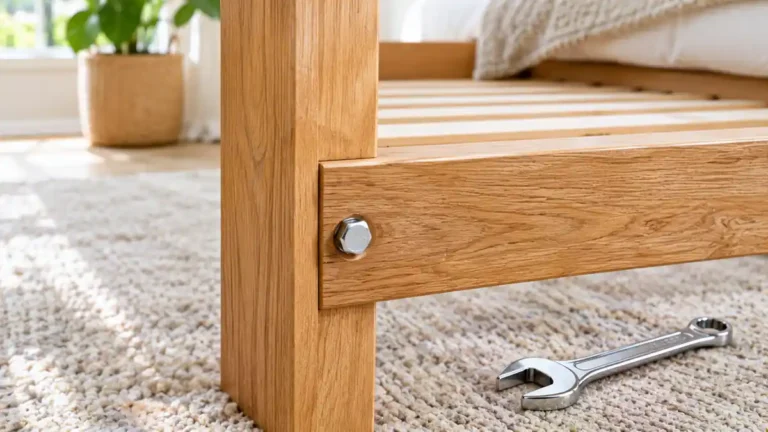
Key points: many wood frames ship flat and need assembly with a screwdriver or Allen key; read the instructions and lay out the parts; two people make assembly easier; check that all slats are placed correctly; do not fully tighten bolts until everything is aligned, then tighten; keep the Allen key. You will need it to retighten; check delivery size and door clearance.
Some frames are tool-free with simple fits. Check reviews for difficulty.
Care
Key points: dust with a dry cloth; wipe with a damp cloth, and dry; avoid harsh chemicals; keep out of direct sun to prevent fading; control room humidity to prevent warping; use a mattress protector to keep spills off the wood; lift, do not drag the frame; check joints every few months.
What are the main strengths and weaknesses?
On the plus side: sturdy and long lasting; warm and classic look; many styles and sizes; does not need a box spring in platform designs; can be refinished (solid wood). On the downside: heavier than metal; can squeak if joints loosen; costs more than basic metal frames; quality varies, especially with engineered wood; some need assembly.
How to Choose a Wood Bed Frame
Pick a style: slatted platform, solid platform or traditional. Check your mattress type and warranty rules. Check slat spacing, aiming for 3 inches or less. Check the weight capacity and add a safety margin. Check the wood and joints. Look for a center support on queen and king sizes. Check the height and clearance. Plan delivery and assembly. Check the warranty. Read reviews for squeaks and sturdiness.
What mistakes should you avoid?
A few common mistakes are worth avoiding: ignoring slat spacing and voiding the warranty; choosing a frame rated too close to your load; skipping center support on large sizes; not tightening bolts over time; buying for looks only; forgetting delivery access.
Frequently Asked Questions
Do I need a box spring with a wood platform bed?
Usually not. Slats or a solid platform support the mattress. Check the maker.
How far apart should slats be?
One guide says 3 inches or less to protect your mattress warranty. Check your warranty.
How much weight can a wood bed frame hold?
Often 400 to 650 pounds, but ratings vary. Check the spec.
Why does my wood bed frame squeak?
Loose joints or wood rubbing wood. Tighten bolts and add padding.
Is solid wood better than engineered wood?
Solid wood usually lasts longer. Good plywood slats can also be strong.
Can I use a memory foam mattress on slats?
Yes, with closely spaced slats or a solid platform.
Can I put a wood frame on carpet?
Yes. Use pads to protect the floor and keep it level.
Conclusion
A wood bed frame is a sturdy, classic base for your mattress. Choose a style that suits your mattress type, check slat spacing and weight capacity, and look for tight joints and good support.
Tighten the hardware over time and protect the wood with a mattress protector. With the right frame, your bed will stay quiet, sturdy and good-looking for many years.
Related guides
 Rattan Bed Frame: Three Constructions, Natural vs Synthetic and Weight CapacityA rattan bed frame is a bed with a woven rattan headboard, footboard or sides. The weave is mostly a look, and…Read more →
 Bed Frame with Headboard Guide: Wood, Metal and Upholstered Types, Headboard Height, Width and AttachmentQuick answer: a bed frame with a headboard combines the base and the headboard in one piece. Headboard width…Read more →
 Floor Bed Frame Guide: Low Profile and Montessori Beds, Slats, Airflow, Mold and SafetyQuick answer: a floor bed frame holds a mattress just above the floor. A slatted base lets air move under the…Read more →
 Bed in a Bag: What’s Included, Sizes and How to Check QualityA bed in a bag is a full set of bedding sold as a single purchase. It usually includes a comforter, a fitted…Read more →