
LED Mirror Guide: IP44 Rating, 4000K Light, CRI 90+, Anti-Fog Pads, Dimming and Size
Quick answer: a good LED bathroom mirror has a water-protection rating of at least IP44, a neutral 4000K light for grooming, a color rendering index (CRI) of 90 or higher, a heated defogger pad instead of just a coating and dimming with a memory function. Size it to your vanity and have a licensed electrician check the wiring.
This article is part of our bathroom storage and mirror guide, where you can compare related options.
An LED mirror combines a mirror and a light source, so you get even light on your face without separate sconces. It looks modern, saves space and can make a small bathroom brighter. But the market is full of products with confusing specs. This guide explains the features that matter, which ratings to look for, how to choose size and placement, what to know about installation and safety and how to avoid common mistakes. This is not electrical advice. See the standing mirror and vanity table guides for non-bathroom mirror ideas.
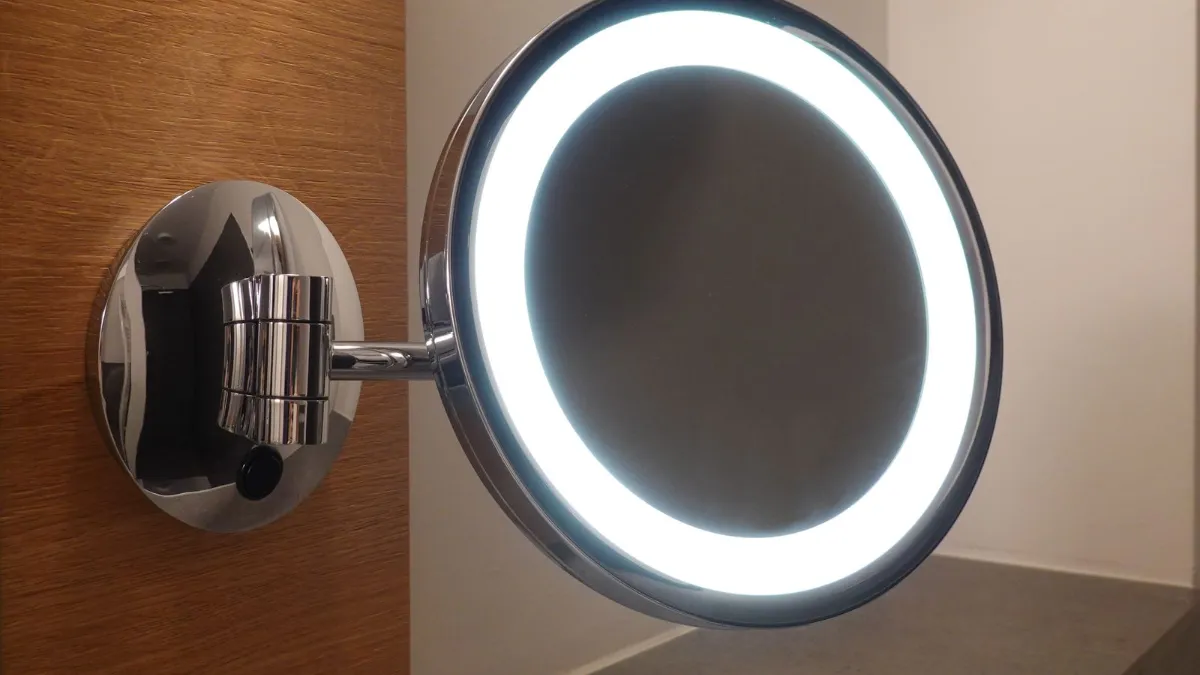
What Is an LED Mirror?
An LED mirror has LED lights built into the frame or behind the glass. Types: Backlit (halo) mirror. Light glows around the edge from behind. Front-lit mirror. Light shines forward through a strip on the glass face. Edge-lit or frame-lit mirror. Light sits in the frame. Mirror cabinet with LED. Medicine cabinet with lights. Hollywood-style mirror. Bulbs around the frame, common for makeup. See the vanity table guide. Smart mirror. With touch controls, clocks or speakers.
Some mirrors combine backlit and front-lit LEDs.
IP Rating: Water Protection
Bathrooms are wet, so the IP rating matters. Guides generally call for at least IP44 for a vanity area. One source says a quality bathroom mirror with LED lighting will have an IP44 or IP65 rating. Another suggests at least IPX4. One listing in the results is only IP22 damp-rated, which offers less protection than IP44.
Plain explanation: the first digit is protection against solids, and the second digit is protection against water. A 4 in the second digit means splash-resistant. Check the rating on the spec sheet, and ask where it applies, since local code can limit placement near showers and tubs.
Color Temperature
Guides commonly suggest 4000K for grooming. One says for optimal grooming, choose 4000K (neutral white). Many products offer adjustable settings such as 3000K (warm), 4500K and 6000K (cool daylight).
Key points: 3000K feels cozy and flattering at night; 4000K is neutral and good for makeup and shaving; 6000K feels like bright daylight but can look harsh.
A mirror with three color modes is flexible. Compare with the lighting advice in the vanity table guide, which recommends 4000 to 5000K for makeup.
CRI: Color Accuracy
CRI (Color Rendering Index) tells you how accurately a light shows colors. The consensus in the search is 90 or higher. Some budget models list only CRI of 85 or more. A higher CRI shows skin tones and makeup more truthfully. Check the spec sheet. Claims such as “CRI 95+” are listing claims.
Anti-Fog
Fog on a bathroom mirror is annoying. Guides say heated defogger pads are generally more reliable than coatings. One guide advises that the words “built-in defogger” or “heating pad” in the specs matter more than a generic “anti-fog” claim. Some models include auto-off timers, and one has a 30-minute auto-off anti-fog pad. Look for a switch that is easy to reach.
Dimming and Memory
Useful features include: dimmable brightness from low to high; memory function, which returns to your last brightness and color setting; touch sensor switch. Check that it works with wet fingers; night light mode; adjustable color temperature.
Size and Shape
The results offered less direct guidance on size. Common listings range from about 24 by 32 inches for a single vanity to much larger wall mirrors, including 36 by 24 and 40 by 32 inch models. Practical rules: Measure the vanity width and the wall space. Make the mirror a little narrower than the vanity, or equal to it. Leave space above the faucet and below the ceiling. Check the mirror’s depth and the mounting height so the lights hit your face at eye level. Round and oval mirrors soften a bathroom. Rectangles feel modern. Vertical orientation suits narrow walls.
See the small vanity guide for vanity widths and the standing mirror guide for freestanding styles.
Power and Installation
LED mirrors need power. Options: Hardwired. A licensed electrician connects it to a junction box. Plug-in. Uses an outlet or a plug adapter, but the cord may be visible. Battery. Rare for large mirrors.
Bathrooms have special rules for outlets and fixtures near water (GFCI protection and zones). I did not verify local code here. Ask a licensed electrician, and follow the manufacturer’s instructions. Mount the mirror into studs or with rated anchors because glass is heavy.
Safety Checks
Check for a safety certification mark such as UL, ETL or CE, depending on your country, on the listing and the product. Check that the mirror uses shatterproof or tempered glass. Listings describe “shatterproof” glass or backing, though I did not verify claims. Keep cords away from water. Do not use a damaged mirror. Turn off power before cleaning or servicing. Check that the mounting is secure.
Cleaning
Key points: turn off power; wipe with a soft microfiber cloth; use a glass cleaner without ammonia on edges if the maker advises; avoid spraying directly on LED strips; dry the frame.
LED Mirror vs Regular Mirror with Sconces
| Feature | LED mirror | Mirror with sconces |
|---|---|---|
| Light spread | Even | Depends on placement |
| Space | Compact | Needs wall space |
| Wiring | One connection | Two fixtures |
| Look | Modern | Traditional |
What are the main strengths and weaknesses?
On the plus side: even, shadow-free light; space-saving and modern; anti-fog and dimming options; brightens small bathrooms. On the downside: needs power and installation; cheap models have low CRI or weak IP ratings; specs can be confusing; LED failure may mean replacing the whole mirror.
How to Choose an LED Mirror
Measure the vanity and wall. Check the IP rating: at least IP44. Choose the color temperature: 4000K or adjustable. Check CRI: 90 or higher. Check anti-fog: a heated pad. Check dimming and memory. Choose backlit, front-lit or both. Plan power and installation with an electrician. Check safety marks and glass. Read reviews and warranty.
What mistakes should you avoid?
A few common mistakes are worth avoiding: choosing IP22 for a bathroom; ignoring CRI; trusting a generic “anti-fog” claim; buying a mirror wider than the vanity wall; skipping an electrician; mounting without studs.
Frequently Asked Questions
What IP rating should a bathroom LED mirror have?
At least IP44, per the guides. IP65 is better near water.
What color temperature is best?
About 4000K for grooming. Adjustable models are handy.
What CRI should I look for?
90 or higher.
Do I need a heated defogger?
Guides say heated pads are more reliable than coatings.
What size LED mirror should I buy?
Measure your vanity. Common sizes include 24 by 32 inches for a single vanity.
Can I install an LED mirror myself?
Plug-in models may be easy, but hardwired ones need a licensed electrician.
Conclusion
A good LED mirror gives clear, flattering light, resists water and stays fog-free. Look for IP44 or higher, 4000K light, CRI 90 or more and a heated defogger pad.
Measure your vanity, plan the power and ask an electrician for help. Then your bathroom mirror will work well every morning.
Related guides
 Smart Mirror Guide: LED Lighting, Anti-Fog, Bluetooth, Wiring and How to ChooseA smart mirror is a bathroom mirror with extra features built in: LED lights, an anti-fog heater, touch…Read more →
 Bathroom Mirrors: Size Rules, Height, Lighting and Anti-Fog OptionsA bathroom mirror does a lot. You use it to shave, do makeup, brush your teeth and check your outfit. It also…Read more →
 Medicine Cabinet with Mirror: Recessed vs Surface Mount, Sizes and InstallationA medicine cabinet with a mirror does two jobs in one spot above your sink. It gives you a mirror for grooming,…Read more →
 Small Laundry Room Ideas: Stacked Machines, Folding Counters, Vertical Storage and Layouts That WorkQuick answer: the best small laundry room ideas are to stack the washer and dryer, add a folding counter or…Read more →


2 Comments