
Small Laundry Room Ideas: Stacked Machines, Folding Counters, Vertical Storage and Layouts That Work
Quick answer: the best small laundry room ideas are to stack the washer and dryer, add a folding counter or fold-down shelf, use the wall space above the machines for cabinets or shelves, and plan a simple workflow from machine to counter to hamper. Always leave the ventilation space your machine manual asks for.
This article is part of our bathroom remodel guide, where you can compare related options.
Laundry is a chore that happens in the smallest rooms of many US homes: a closet, a hallway nook, a corner of the bathroom or a narrow room off the kitchen. A small space does not have to feel cramped. With a clear plan, a few smart pieces and good habits, you can wash, dry, fold and put away without tripping over baskets. This guide explains layouts, stacking, folding surfaces, storage, doors, lighting, finishes and a simple way to choose, using design and appliance-retailer advice.
Start with the Workflow
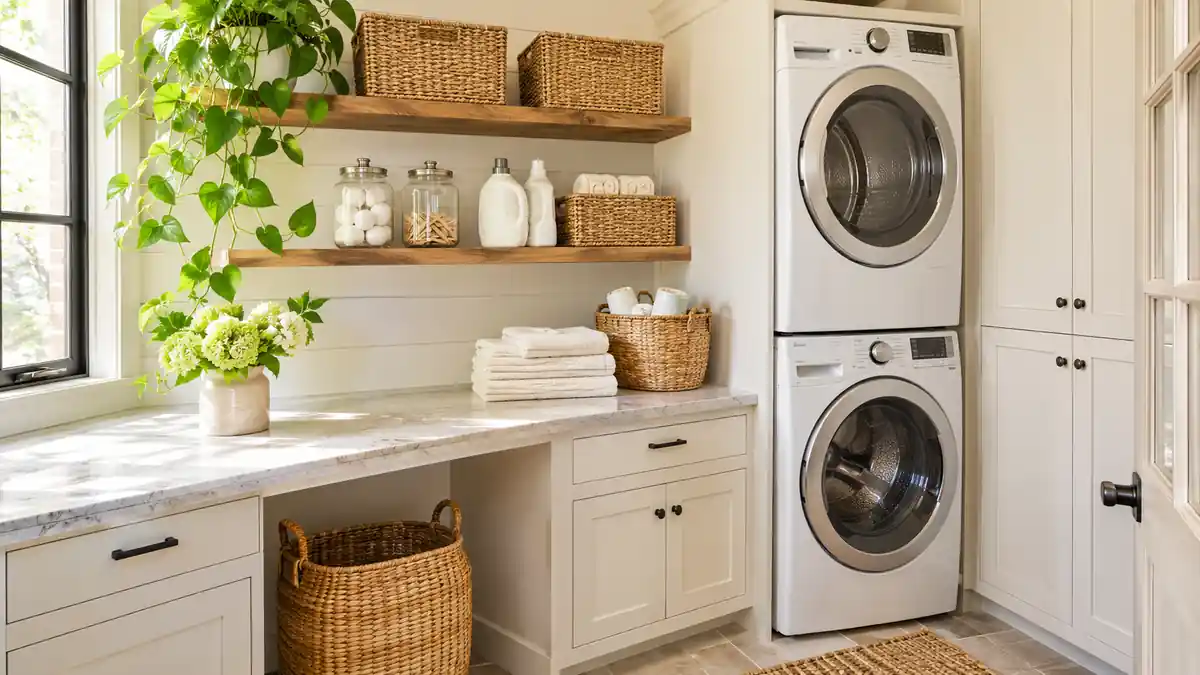
Laundry follows a pattern: sort, wash, dry, fold, put away. Design guides describe a “work triangle” of machine, counter and hamper or storage. Put the folding surface close to the machines and keep storage bins within one step. If you can do the whole cycle without crossing the room, the space works, even if it is small.
Ask yourself: where do dirty clothes wait?; where do clean clothes get folded?; where do supplies live?; where do hang-dry items go?.
Then design around those four needs.
Idea 1: Stack the Washer and Dryer
Stacking is the most common and most effective floor-space saver. Guides note stackable units suit narrow rooms, closets, hallways, apartments and condos, because they free up floor area for hampers, storage or a folding station.
Things to check: Compatible models. Use a stacking kit made for your brand and models. Height. Measure floor to ceiling and leave room for the top control panel and the door swing. Reach. A very tall stack can be hard for shorter people to reach. Front-loader vs top-loader. Only front-loaders stack in most cases. A washer-dryer combo or an all-in-one unit is another option for tiny spaces. Door swing. Make sure the doors open fully, or buy reversible doors.
If you cannot stack, a side-by-side pair with a counter over both is the next best choice. Under-counter models can slide under a counter too, if you choose compact units.
Idea 2: Add a Folding Surface
A flat place to fold turns a cramped nook into a working laundry room. Options: Counter over side-by-side machines. One guide notes a countertop over a pair becomes a folding station without using extra floor space. This works with front-loaders whose tops are level. Fold-down shelf. Wall-mounted and hinged, it lifts away when not in use. Pull-out board. A slim board slides from a cabinet. Over-the-machine shelf. A deep shelf above is useful for storing, not folding. Rolling cart. A narrow cart can hold baskets and roll away.
Choose a moisture-friendly surface such as laminate, butcher block that is sealed, quartz or solid surface. See the bathroom organizer guide for moisture-safe materials.
Idea 3: Use Vertical Space
When the floor is full, go up.
Cabinets above the machines. Hold detergent, softener and stain removers. Keep a safe reach height and store chemicals out of children’s reach. Floating shelves. Install shelves above the washer and dryer for essentials. Wall rail with hooks. For lint rollers, bags and brushes. Over-the-door racks. Good for an ironing board and spray bottles. Pegboard or slat wall. Flexible and cheap. Tall narrow cabinet beside the machines for cleaning supplies. Hanging rod. A rod above the folding counter for air-dry items.
Keep heavy items low and light items high. Anchor tall cabinets and shelves to wall studs.
Idea 4: Hampers and Sorting
Pull-out hampers in a cabinet hide clutter. Design guides mention these as a daily-routine helper. Wall-mounted bag hamper on a door. Slim rolling hamper that slides under a counter. Three-bin sorter for lights, darks and delicates. Hidden hamper in a bench. See the storage bench ideas in the small bedroom ideas guide.
Idea 5: Space-Saving Doors
Traditional swing doors take up space. Sliding or pocket doors improve access in compact layouts. A bi-fold door, a barn-style slider or a curtain are all lighter options for a closet laundry. If you have a swing door, check that it does not hit the machines.
Idea 6: Ironing and Drying
Key points: fold-down ironing board. A wall-mounted ironing board closes away when not in use; over-the-door ironing board; wall-mounted drying rack that folds flat; retractable clothesline; ceiling-mounted rack for rooms with a high ceiling.
If you hang clothes to dry, make sure the room has ventilation to avoid damp air and mold. See the how to clean a shower curtain guide for general mildew-control habits in humid rooms.
Ventilation and Clearance
Machines need space to breathe. One guide suggests at least 1 inch on the sides and 3 to 4 inches at the back for ventilation, in line with the manufacturer’s guidelines. The exact numbers vary by model, so check the install manual. Dryers also need a proper vent to the outside, and the duct should be kept short and clean. Lint buildup is a fire risk, so clean the lint trap every load and the vent duct regularly.
If you are installing new, ask a licensed professional about hookups, venting, water shutoff valves, drain pans and local codes. This guide is not a substitute for the manual or a licensed installer.
Lighting and Color
A small room feels bigger with good light.
Key points: bright overhead light or a flush-mount fixture; under-cabinet LED strips over the folding counter; light, reflective paint such as soft white or pale gray; washable, mildew-resistant paint for humid walls; a glossy or satin finish that wipes clean.
A little color in cabinet doors or a patterned floor tile can make a tiny room fun.
Flooring
Choose flooring that handles water and spills. Sheet vinyl, luxury vinyl plank and ceramic tile are common choices. Avoid carpet. A small drain pan or leak sensor under the washer is a cheap protection against floods. Add a moisture mat if the floor is wood.
Make a Closet or Nook Work
Key points: use a stacked pair and bifold doors; add a shelf above the stack; keep detergent in one lidded basket; hang a small mirror or art to make it feel finished; add a vent or louvered doors for airflow when the dryer runs.
Do not close the door on a running dryer unless the room is ventilated as the manual states.
Laundry in a Bathroom or Kitchen
When the machines share a room, treat laundry as part of the room. In a bathroom, pick moisture-friendly cabinets and a countertop over the machines. In a kitchen, a hidden-door cabinet lets you close the laundry away. See the small bathroom remodel and modern bathroom ideas guides.
What are the main strengths and weaknesses?
| Layout | Pros | Cons |
|---|---|---|
| Stacked pair | Saves floor, frees space for storage | Higher controls, special kit |
| Side-by-side with counter | Folding surface included | Needs more width |
| Under-counter compact | Fits in tight spots | Small capacity |
| Closet with bifold doors | Hides laundry | Needs ventilation |
| Combo washer-dryer | Smallest footprint | Slower cycles |
How to Plan Your Small Laundry Room
Measure width, depth, height, door swing and window placement. Check the machine manuals for clearances and vent rules. Choose the layout: stacked, side-by-side or combo. Add a folding surface. Add vertical storage. Plan a hamper system. Choose a space-saving door. Set up lighting, flooring and paint. Plan ventilation and cleaning habits. Set a budget and shop.
What mistakes should you avoid?
A few common mistakes are worth avoiding: buying machines before measuring; forgetting the door swing; skipping dryer vent cleaning; blocking the airflow around machines; storing chemicals within a child’s reach; using flooring that swells in water.
Frequently Asked Questions
What is the best layout for a small laundry room?
A stacked washer and dryer with a shelf above and a folding surface nearby is often the best.
How much clearance do washers and dryers need?
Follow the manual. One source suggests about 1 inch at the sides and 3 to 4 inches at the back for ventilation.
How can I add a folding table in a tiny laundry room?
Use a countertop over side-by-side machines, a fold-down shelf or a pull-out board.
Are sliding doors good for laundry rooms?
Yes. Sliding or pocket doors save swing space.
What flooring is best?
Water-resistant options such as vinyl or tile.
Can I put a laundry in a closet?
Yes, with proper ventilation, venting and electrical or plumbing hookups. Ask a licensed pro.
Conclusion
A small laundry room works best when it follows your workflow. Stack the machines, add a fold-down or countertop folding spot, use the wall for storage and keep the airflow clear. A bright, tidy room makes laundry day feel less like a chore.
Measure first, read the machine manuals and ask a pro about venting and hookups. Then add the small touches, like a hidden hamper or a pretty light, that make the space yours.
Related guides
 Laundry Room Ideas: Layouts, Storage, Folding Counters and Small-Space TipsLaundry is a job you do every week, so the room where you do it should work for you. A well-planned laundry…Read more →
 Small Bathroom Ideas: Layout, Storage, Color and Fixture TipsA small bathroom doesn t have to feel cramped. The right layout, fixtures and colors can make even a tiny room…Read more →
 Powder Room Guide: Size, Layout, Clearances (15 and 21 Inches), Ideas and Door ChoicesQuick answer: a powder room, or half bath, has a toilet and a sink but no shower or tub. Most sources put it at…Read more →
 Small Vanity Guide: 24-Inch Bathroom Vanity Size, Depth, Height, Clearance and Storage IdeasQuick answer: a small bathroom vanity is usually 18 to 30 inches wide. A 24-inch vanity is a practical middle…Read more →


12 Comments