Rotating Bookshelf Guide: Sizes, Clearance, Weight Capacity and How to Choose
A rotating bookshelf lets you spin your books around to find the one you want. It stores a lot of books in a small footprint, it can sit in the middle of a room and it is a conversation piece. It is also a piece of furniture that needs more thought than a regular shelf, because it turns. It needs clearance to rotate, a stable base and shelves that can handle a load that shifts as the unit moves.
This article is part of our shelves, bookcases and storage furniture guide, where you can compare related options.
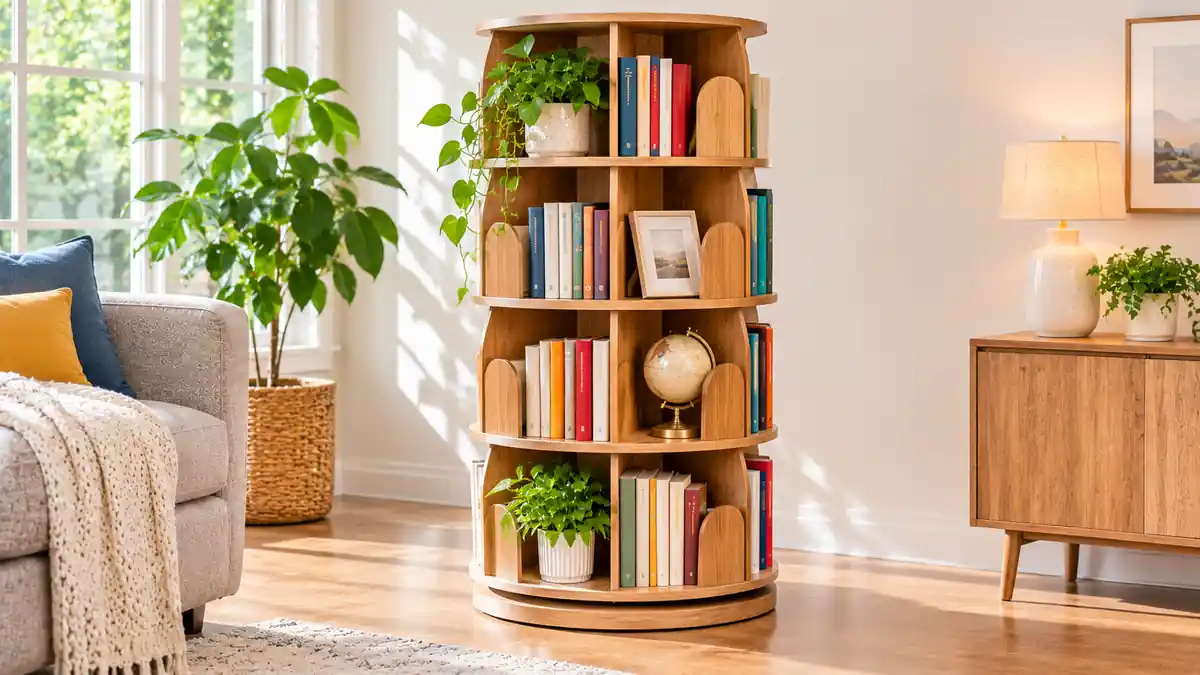
A rotating bookshelf, also called a revolving bookcase, is a shelving unit built around a central axis, so the shelves rotate. It may be round or square, tall or short, with 3 to 6 tiers. This guide explains how it works, how much space it needs, what weight it can hold, which materials are best, how to avoid tipping and how to style and use one.
How a Rotating Bookshelf Works
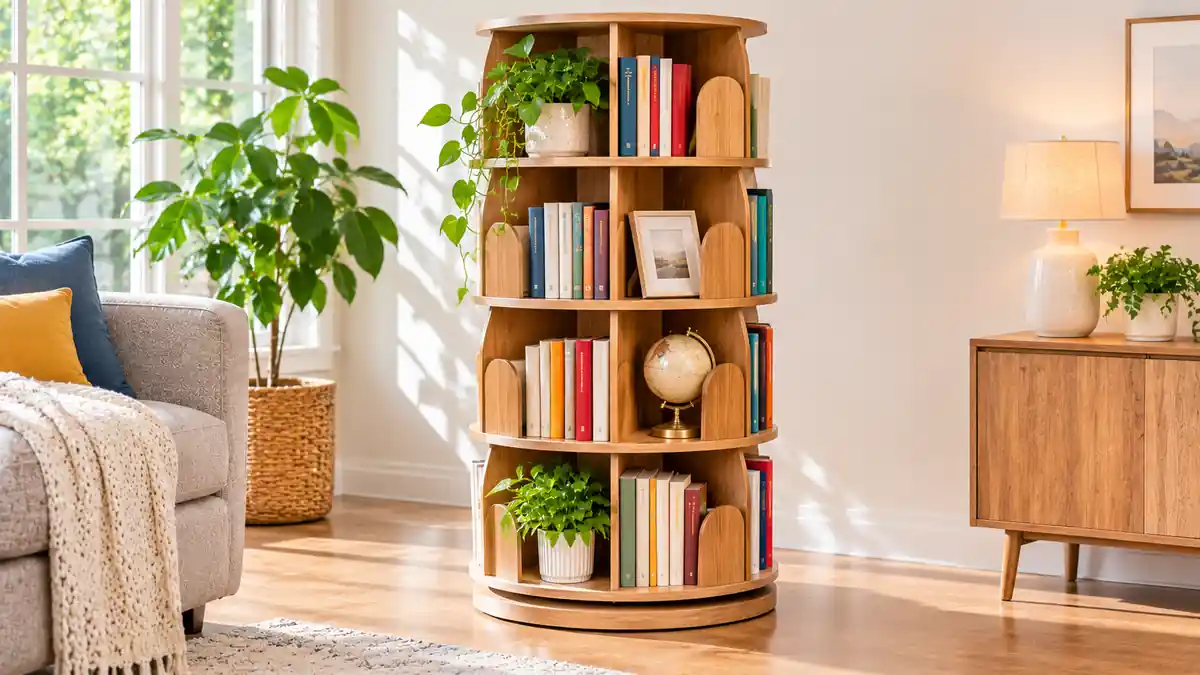
A rotating bookshelf has a central post and a bearing at the base. The shelves, often in a square or circular shape, attach to the post and spin. Some units rotate each shelf separately, and others rotate all the tiers together. Some are on a fixed base. Others have a wide, flat base for stability.
Common types: Tiered round bookshelf. Circular shelves that spin on a post. Square revolving bookcase. Square tiers, often on a cross-shaped base. Rotating cube shelf. A cube of shelves that rotates on a base. Spinning display tower. A narrow tower for books, media or decor. Rotating corner unit. Fits a corner and spins.
Clearance: The Swing Space
A rotating unit needs open floor to turn, not just a footprint. One guide notes that a square base sitting flat on the floor might seem small, but as it rotates, its corners sweep a much larger circular path. Measure the full swing radius and make sure it will not hit walls, furniture or doors.
Freestanding position. If you place it beside a sofa or use it as a low room divider, the swing radius is less restricted by walls. See the room divider guide. Corner position. For tight corners, one guide suggests a compact round unit with a diameter of about 40 to 45 centimeters (about 16 to 18 inches). Walkways. Leave enough room to walk past while the unit turns.
Tape the swing circle on the floor before you buy.
Height and Visual Weight
Tall units store more in less floor area, but they can overwhelm a small room. One guide warns that a tall, dark wood rotating bookshelf can dominate a small study or bedroom and make it feel cramped even if it technically fits. Taller five- or six-tier models suit larger living rooms or open-plan spaces. For small rooms, choose a shorter, lighter-colored unit.
Weight Capacity
Specs differ widely, so check the per-shelf rating rather than assuming. Examples from retailer listings: A steel-base 5-tier unit lists a shelf weight capacity of 200 pounds. Another unit lists a shelf weight capacity of 60 pounds.
Because the whole collection sits on a central bearing, one guide recommends putting heavy textbooks, encyclopedias and binders on the lowest shelf, and keeping paperbacks and lightweight items on the upper tiers. Another adds that a rotating bookshelf carries load unevenly as it spins, so confirm the rating per shelf before loading it with heavy hardbacks or decorative ceramics.
Tips: spread weight evenly around the unit; do not overload one side; put the heaviest items low; check the total weight rating of the unit and the base; do not let children climb on or spin a heavily loaded unit.
Stability and Safety
Wide, solid base. On carpet, look for wide, flat bases that spread weight, not small feet. Anti-tip hardware. One listing notes that its tip-over restraint device is not included, so check whether anti-tip hardware comes with your unit, especially if you have children or plan to load the top heavily. Smooth rotation. The bearing should turn easily without grinding. Brake or lock. Some units lock in place. Level floor. Place on a flat surface. Keep fingers clear of the moving parts.
If the bookshelf is tall and the rotation is smooth, a loaded top can make it tippy. Keep top shelves light.
Materials
Steel frame with wood shelves. Offers strength and a clean look. Solid wood. Heavy, strong and warm. Susceptible to cracking or warping with moisture. Engineered wood (MDF, particleboard). Common and affordable. Check shelf thickness for sagging. Glass. Brittle and with limited weight capacity. Not ideal for books. Metal. Strong and slim. Plastic. Light, low cost and lower capacity.
For heavy books, choose steel and solid wood or thick plywood. See the small bookshelf guide for material thickness notes.
How Much Storage Do You Need?
One guide recommends roughly 20 to 30% more storage capacity than you currently need. Product pages give book counts that vary widely, so treat them as rough estimates. Measure your books. Large coffee table books need deeper and taller shelves. Count how many books you have and how many you may buy.
Where to Put a Rotating Bookshelf
Key points: living room. Beside a sofa or armchair; study or office. Within arm’s reach of a desk; bedroom. A reading corner; kids’ room. A fun way to store books, with sturdy construction and safe placement; library or reading nook. As a focal piece; hallway or open space. As a divider.
Avoid placing it in front of a door or in a tight walkway.
Styling
Mix books and decor, but keep weight in mind. Group books by color or genre so you can find them easily. Use baskets for small items. Leave a little empty space so it does not look cluttered. Place a plant on a top shelf if the unit is stable and the plant is light. Choose a finish that matches your furniture.
See the bookends guide for keeping books upright.
What are the main strengths and weaknesses?
On the plus side: stores many books in a small footprint; easy to find books by spinning; works as a room divider or focal point; fun for kids and adults. On the downside: needs swing clearance; loaded weight can be uneven; tall units can look bulky; quality varies by price; rotating parts can wear out.
How to Choose a Rotating Bookshelf
Measure the swing space, not only the footprint. Decide on height to suit your room. Check weight capacity per shelf and total. Pick a stable base. Check for anti-tip hardware. Choose a durable material. Estimate your storage needs with 20 to 30% extra. Check rotation smoothness and reviews. Plan placement to avoid doors and walkways.
What mistakes should you avoid?
A few common mistakes are worth avoiding: not measuring the swing radius; overloading one side; ignoring per-shelf weight ratings; choosing a tall dark unit for a small room; skipping anti-tip hardware; using glass shelves for heavy books.
Frequently Asked Questions
What is a rotating bookshelf?
A shelving unit that spins around a central axis so you can access books from all sides.
How much space does a rotating bookshelf need?
You need room for the full swing, plus walking space. Measure the radius, not only the footprint.
How much weight can it hold?
It varies. Examples range from about 60 to 200 pounds per shelf. Check the product.
Are rotating bookshelves stable?
They can be, with a wide, solid base. Check anti-tip hardware.
Can I use one in a small room?
Yes, with a compact round unit, but check the swing space.
What materials are best?
Steel frames with solid wood or thick shelves are strong. Avoid glass for heavy books.
Are they good for kids?
They can be, if sturdy and placed safely. Supervise young children.
Conclusion
A rotating bookshelf is a clever way to store a lot of books in a small footprint. Check the swing clearance, per-shelf weight capacity and base stability, and choose durable materials.
Load the heaviest items low, use any anti-tip hardware and give the unit space to spin. With the right choice, a rotating bookshelf is both useful and fun.
Related guides
 Ladder Bookshelf Guide: Leaning Angle, Depth, Weight Capacity and Why You Should Anchor ItQuick answer: a ladder bookshelf leans against a wall, with a wide base and narrowing shelves that step back…Read more →
 White Bookshelf Guide: Shelf Depth, Weight Capacity, Anchoring, Finishes and StylingQuick answer: a good white bookshelf matches its shelf depth to your books (about 15 to 20 centimeters for…Read more →
 Small Bookshelf Guide: Sizes, Materials, Anchoring and Ideas for Tight SpacesA small bookshelf can do a lot in a small home. It holds your favorite books, fills an awkward corner and adds…Read more →
 Rocker Recliner: Rocker vs Glider, Swivel Options and Whether It Suits a NurseryA rocker recliner combines a rocking or gliding motion with a reclining back and footrest. Rockers move in an…Read more →